INDIA &pakistan
Relations between India and Pakistan have been complex due to a number of historical and political events. Relations between the two states have been defined by the violent
partition of British India in 1947, the
Kashmir conflict and the numerous
military conflictsfought between the two nations. Consequently, even though the two
South Asian nations share
linguistic, cultural, geographic, and economic links, their relationship has been plagued by hostility and suspicion.
Since the election of new governments in both India and Pakistan in the early 2010s, significant steps have been taken to improve relations, in particular developing a consensus on the agreement of Non-Discriminatory Market Access on Reciprocal Basis (NDMARB) status for each other, which will liberalize trade.
[6] In late 2015, meetings were held between the foreign secretaries and the national security advisers of both nations, at which both sides agreed to thoroughly discuss hurdles remaining in the relationship. In November 2015, the new Indian Prime Minister,
Narendra Modi and Pakistani Prime Minister
Nawaz Sharif agreed to the resumption of bilateral talks; the following month, Prime Minister Modi made a brief, unscheduled visit to Pakistan while en route to India, becoming the first Indian Prime Minister to visit Pakistan since 2004.
[7] Despite those efforts, relations between the countries have remained frigid, following repeated acts of cross-border terrorism. According to a 2014
BBC World Service Poll, 17% of Indians view Pakistan's influence positively, with 49% expressing a negative view, while 21% of Pakistanis view India's influence positively, with 58% expressing a negative view.
[8]
Country comparison
|  India India |  Pakistan Pakistan |
|---|
| Population | 1,210,193,422[9] | 170,600,000 |
| Area | 3,287,240 km² (1,269,210 sq mi) | 796,095 km² (307,374 sq mi) |
| Population density | 382/km² (922/sq mi) | 214.3/km² (555/sq mi) |
| Capital | New Delhi | Islamabad |
| Largest city | Mumbai | Karachi |
| Government | Federal republic, Parliamentary democracy | Islamic Parliamentary Republic |
| Official languages | Hindi, English and 20 other official languages | Urdu |
| Main religions | 80.5% Hinduism, 13.4% Islam, 2.3% Christianity, 1.9% Sikhism, 0.8% Buddhism, 0.4% Jainism[10] | 95-98% Islam (80-95% Sunni, 5-20% Shi'a), 1.6% Christianity, 1.6%Hinduism, others |
| GDP (nominal) | $2.048 trillion ($1,626 per capita) | $236.518 billion ($1,295 per capita) |
| GDP (PPP) | $7.277 trillion ($5,777 per capita) | $855 billion ($4,699 per capita) |
| Military expenditures | $36.03 billion (1.83% of GDP) | $5.1 billion (2.8% of GDP) |
Seeds of conflict during independence
About half a million Muslims and Hindus were killed in communal riots following the
partition of British India. Millions of Muslims living in India and Hindus and
Sikhs living in Pakistan emigrated in one of the most colossal transfers of population in the modern era. Both countries accused each other of not providing adequate security to the minorities emigrating through their territory. This served to increase tensions between the newly-born countries.
According to the British plan for the partition of British India, all the 680
princely states were allowed to decide which of the two countries to join. With the exception of a few, most of the Muslim-majority princely-states acceded to Pakistan while most of the Hindu-majority princely states joined India. However, the decisions of some of the princely-states would shape the Pakistan-India relationship considerably in the years to come.
Junagadh issue
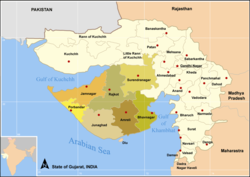
Junagadh is one of the modern districts of
Saurastra, Gujarat
Junagadh was a state on the southwestern end of
Gujarat, with the principalities of Manavadar, Mangrol and Babriawad. It was not contiguous to Pakistan and other states physically separated it from Pakistan. The state had an overwhelming Hindu population which constituted more than 80% of its citizens, while its ruler,
Nawab Mahabat Khan, was a Muslim. Mahabat Khan acceded to Pakistan on 15 August 1947. Pakistan confirmed the acceptance of the accession on 15 September 1947.
India did not accept the accession as legitimate. The Indian point of view was that Junagadh was not contiguous to Pakistan, that the Hindu majority of Junagadh wanted it to be a part of India, and that the state was surrounded by Indian territory on three sides.
The Pakistani point of view was that since Junagadh had a ruler and governing body who chose to accede to Pakistan, it should be allowed to do so. Also, because Junagadh had a coastline, it could have maintained maritime links with Pakistan even as an
enclavewithin India.
Neither of the states was able to resolve this issue amicably and it only added fuel to an already charged environment.
Sardar Patel, India's
Home Minister, felt that if Junagadh was permitted to go to Pakistan, it would create communal unrest across Gujarat. The government of India gave Pakistan time to void the accession and hold a plebiscite in Junagadh to pre-empt any violence in Gujarat.
Samaldas Gandhi formed a government-in-exile, the
Arzi Hukumat (in
Urdu:
Arzi: Transitional,
Hukumat: Government) of the people of Junagadh. Patel ordered the annexation of Junagadh's three principalities.
India
cut off supplies of fuel and coal to Junagadh, severed air and postal links, sent troops to the frontier, and occupied the
principalities of Mangrol and Babariawad that had acceded to India.
[11] On 26 October, Nawab of Junagadh and his family fled to Pakistan following clashes with Indian troops. On 7 November, Junagadh's court, facing collapse, invited the Government of India to take over the State's administration. The Dewan of Junagadh, Sir
Shah Nawaz Bhutto, the father of the more famous
Zulfiqar Ali Bhutto, decided to invite the
Government of India to intervene and wrote a letter to Mr. Buch, the Regional Commissioner of
Saurashtra in the Government of India to this effect.
[12] The
Government of Pakistan protested. The government of India rejected the protests of Pakistan and accepted the invitation of the Dewan to intervene.
[13] Indian troops occupied Junagadh on 9 November 1947. In February 1948, a plebiscate held almost unanimously voted for accession to India.
Kashmir conflict
Despite the standstill agreement with Pakistan, team of Pakistani forces were dispatched into Kashmir in response to the Hindu Maharajah's attempted genocide of Muslims in the state. The Maharajah of Kashmir attempted to change the predominantly Muslim demographics of his state by engaging in an ethnic cleansing of Muslims from the Jammu section of his state,
[15] as his state forces massacred thousands of Muslims in Jammu and expelled thousands more from their homes in an effort to shift the population ratio in favour of Hindus.
[16] This precipitated a revolt by the Muslims in the Poonch district of Jammu and Kashmir against the Hindu Maharajah.
[17] Backed by Pakistani paramilitary forces,
Pashtun Mehsud tribals
[18] invaded Kashmir in October 1947 under the code name "Operation Gulmarg" to seize Kashmir. They reached and captured
Baramulla on 25 October. Instead of moving on to Srinagar just 50 km away and capturing its undefended airfield, they stayed there for several days. Kashmir's security forces turned out to be too weak and ill-equipped to fight against Pakistan. Fearing that this invasion would bring about an accession to Pakistan, the Maharaja now turned to India and requested India for troops to safeguard Kashmir. Indian Prime Minister Nehru was ready to send the troops, but the acting Governor General of India, Lord Mountbatten of Burma, advised the Maharaja to accede to India before India could send its troops. Hence, considering the emergent situation he signed the instrument of accession to the Union of India on 26 October 1947 (see the two-page document's photo below).
Charles Chevenix Trench writes in his 'The Frontier Scouts' (1985):
In October 1947... tribal lashkars hastened in lorries - undoubtedly with official logistic support - into Kashmir... at least one British Officer, Harvey-Kelly took part in the campaign. It seemed that nothing could stop these hordes of tribesmen taking Srinagar with its vital airfield. Indeed nothing did, but their own greed. The
Mahsuds in particular stopped to loot, rape and murder; Indian troops were flown in and the lashkars pushed out of the Vale of Kashmir into the mountains. The Mahsuds returned home in a savage mood, having muffed an easy chance, lost the loot of Srinagar and made fools of themselves.
In the words of Gen Mohammad Akbar Khan (Brigadier-in-Charge, Pakistan, in his book "War for Kashmir in 1947"): "The uncouth raiders delayed in Baramulla for two (whole) days for some unknown reason."
[19]
While the invading Pakistanis spread across the State and looted
Baramulla town just 50 km from the state capital, Srinagar, for several days starting 25 October 1947, the Maharaja signed
Instrument of Accession to the Dominion of India on 26 October 1947. Sheikh Mohammad Abdullah had already reached Delhi a day earlier on 25 October to persuade Nehru to send troops. He made no secret of the danger the State faced and asked Nehru to lose no time in accepting the accession and ensuring the speedy dispatch of Indian troops to the State. (Sheikh Abdullah corroborates this account in his Aatish e Chinaar (at pages 416 and 417) and records (at page 417) that V.P. Menon returned to Delhi on 26 October with signed Instrument of accession.)
[20] These are photos of the two-page Instrument of Accession. The Instrument was accepted by the
Governor-General of India the next day, 27 October 1947. With this signing by the Maharaja and acceptance by the Governor-General, the princely state of Jammu and Kashmir became a part of Dominion of India as per the Indian Independence Act 1947 passed by the British parliament.
By this time the raiders were close to the capital,
Srinagar. Indian troops were airlifted from Delhi, landed at Srinagar airport in Kashmir on 27 October 1947 and secured the airport before proceeding to evict the invaders from Kashmir valley.
The Indian troops managed to evict the aggressors from parts of Kashmir but the onset of winter made much of the state impassable. After weeks of intense fighting between Pakistan and India, Pakistani leaders and the Indian Prime Minister Nehru declared a ceasefire and sought
U.N. arbitration with the promise of a
plebiscite. In 1957, north-western Kashmir was fully integrated into Pakistan, becoming
Azad Kashmir (Pakistan-administered Kashmir). In 1962, China occupied
Aksai Chin, the northeastern region bordering
Ladakh. In 1984, India launched
Operation Meghdoot and captured more than 80% of the
Siachen Glacier.
Pakistan now maintains Kashmiris' right to self-determination through a
plebiscite and the promised plebiscite should be allowed to decide the fate of the Kashmiri people. India on the other hand asserts that with the Maharaja's signing the instrument of accession, Kashmir has become an integral part of India.
Due to all such political differences, this territorial claim has been the subject of wars between the two countries in
1947 and
1965, and a limited conflict in
1999. The state remains divided between the two countries by the
Line of Control (LoC), which demarcates the ceasefire line agreed upon in the 1947 conflict modified in 1972 as per
Simla Agreement.
Wars, conflicts and disputes
India and Pakistan have fought in numerous armed conflicts since their independence. There are three major wars that have taken place between the two states, namely in 1947, 1965 and the Bangladesh Liberation War in 1971. In addition to this was the unofficial
Kargil War and some border skirmishes.
War of 1965
Bangladesh Liberation War
Pakistan, since independence, was geo-politically divided into two major regions,
West Pakistan and
East Pakistan. East Pakistan was occupied mostly by
Bengali people. In December 1971, following a political crisis in East Pakistan, the situation soon spiralled out of control in East Pakistan and India intervened in favour of the rebelling Bengali populace. The conflict, a brief but bloody war, resulted in an independence of East Pakistan. In the war, the Pakistani army swiftly fell to India, forcing the independence of East Pakistan, which separated and became Bangladesh.
Kargil War
During the winter months of 1998-99, the Indian army vacated its posts at very high peaks in
Kargil sector in
Kashmir as it used to do every year.
Pakistani Army intruded across the line of control and occupied the posts. Indian army discovered this in May 1999 when the snow thawed. This resulted in intense fighting between Indian and Pakistani forces, known as the
Kargil conflict. Backed by the Indian Air Force, the Indian Army regained some of the posts that Pakistan has occupied. Pakistan later withdrew from the remaining portion under international pressure.
Other territorial claims
Water disputes
The
Indus Waters Treaty governs the rivers that flow from India into Pakistan. Water is cited as one possible cause for a conflict between the two nations, but to date issues such as the
Nimoo Bazgo Project have been resolved through diplomacy.
[22]
Bengal refugee crisis
In 1949, India recorded close to 1 million Hindu refugees, who flooded into
West Bengal and other states from
East Pakistan (now Bangladesh), owing to communal violence, intimidation and repression from authorities. The plight of the refugees outraged Hindus and Indian nationalists, and the refugee population drained the resources of Indian states, which were unable to absorb them. While not ruling out war, Prime Minister Nehru and Sardar Patel invited
Liaquat Ali Khan for talks in Delhi. Although many Indians termed this appeasement, Nehru signed a pact with Liaquat Ali Khan that pledged both nations to the protection of minorities and creation of minority commissions. Khan and Nehru also signed a trade agreement, and committed to resolving bilateral conflicts through peaceful means. Steadily, hundreds of thousands of Hindus returned to East Pakistan, but the thaw in relations did not last long, primarily owing to the
Kashmir conflict.
Afghanistan
Pakistan has been accused by India, Afghanistan, the United States,
[27][28] the United Kingdom,
[29] of involvement in
terrorism in Kashmir and Afghanistan.
[30] In July 2009, current
President of Pakistan Asif Ali Zardari admitted that the
Pakistani government had "created and nurtured" terrorist groups to achieve its short-term foreign policy goals.
[31]According to an analysis published by Saban Centre for Middle East Policy at
Brookings Institution in 2008 Pakistan was the world's "most active" state sponsor of terrorism including aiding groups and Pakistan has long aided a range of terrorist groups fighting against India in
Kashmir and is a major sponsor of Taliban forces fighting the U.S.-backed government in Afghanistan.
[32]
Insurgency in Kashmir
According to some reports published by the
Council of Foreign Relations, the Pakistan military and the ISI have provided covert support to terrorist groups active in
Kashmir, including the
al-Qaeda affiliate
Jaish-e-Mohammed.
[33][34] Pakistan has denied any involvement in terrorist activities in
Kashmir, arguing that it only provides political and moral support to the
secessionist groups who wish to escape Indian rule. Many Kashmiri militant groups also maintain their headquarters in
Pakistan-administered Kashmir, which is cited as further proof by the Indian government.
Author
Gordon Thomas stated that Pakistan "still sponsored terrorist groups in the state of Kashmir, funding, training and arming them in their war on attrition against India."
[35]Journalist
Stephen Suleyman Schwartz notes that several militant and criminal groups are "backed by senior officers in the Pakistani army, the country's ISI intelligence establishment and other armed bodies of the state."
[36]
List of some insurgent attacks
Insurgents attack on Jammu and Kashmir State Assembly: A car bomb exploded near the Jammu and Kashmir State Assembly on 1 October 2001, killing 27 people on an attack that was blamed on Kashmiri separatists. It was one of the most prominent attacks against India apart from on the
Indian Parliament in December 2001. The dead bodies of the terrorists and the data recovered from them revealed that Pakistan was solely responsible for the activity.
[3]
- 1997 Sangrampora massacre: On 21 March 1997, 7 Kashmiri Pandits were killed in Sangrampora village in the Budgam district.
- Wandhama Massacre: In January 1998, 24 Kashmiri Pandits living in the city Wandhama were killed by nonsense Islamic terrorists.
- Qasim Nagar Attack: On 13 July 2003, armed men believed to be a part of the Lashkar-e-Toiba threw hand grenades at the Qasim Nagar market in Srinagar and then fired on civilians standing nearby killing twenty-seven and injuring many more.[4]
- Assassination of Abdul Ghani Lone: Abdul Ghani Lone, a prominent All Party Hurriyat Conference leader, was assassinated by an unidentified gunmen during a memorial rally in Srinagar. The assassination resulted in wide-scale demonstrations against the Indian occupied-forces for failing to provide enough security cover for Mr. Lone.[5]
- 20 July 2005 Srinagar Bombing: A car bomb exploded near an armoured Indian Army vehicle in the famous Church Lane area in Srinagar killing four Indian Army personnel, one civilian and the suicide bomber. Terrorist group Hizbul Mujahideen, claimed responsibility for the attack.[6]
- Budshah Chowk attack: A terrorist attack on 29 July 2005 at Srinigar's city centre, Budshah Chowk, killed two and left more than 17 people injured. Most of those injured were media journalists.[7]
- Murder of Ghulam Nabi Lone: On 18 October 2005 suspected man killed Jammu and Kashmir's then education minister Ghulam Nabi Lone. No Terrorist group claimed responsibility for the attack. [8]
Insurgent activities elsewhere
The attack on the
Indian Parliament was by far the most dramatic attack carried out allegedly by Pakistani terrorists. India blamed Pakistan for carrying out the attacks, an allegation which Pakistan strongly denied and one that brought both nations to the brink of a
nuclear confrontation in 2001–02. However, international peace efforts ensured the cooling of tensions between the two nuclear-capable nations.
Apart from this, the most notable was the
hijacking of
Indian Airlines Flight IC 814 en route New Delhi from
Kathmandu, Nepal. The plane was hijacked on 24 December 1999 approximately one hour after take off and was taken to
Amritsar airport and then to
Lahore in Pakistan. After refueling the plane took off for
Dubai and then finally landed in
Kandahar, Afghanistan. Under intense media pressure, New Delhi complied with the hijackers' demand and freed
Maulana Masood Azhar from its captivity in return for the freedom of the Indian passengers on the flight. The decision, however, cost New Delhi dearly. Maulana, who is believed to be hiding in
Karachi, later became the leader of
Jaish-e-Mohammed, an organisation which has carried out several terrorist acts against Indian security forces in
Kashmir.
[9]
In 2002, India claimed again that terrorists from Jammu and Kashmir were infiltrating into India, a claim denied by Pakistan President
Pervez Musharraf, who claimed that such infiltration had stopped—India's spokesperson for the External Affairs Ministry did away with Pakistan's claim, calling it "terminological inexactitude."
[37] Only two months later, two Kashmiri terrorists belonging to
Jaish-e-Mohammed raided the
Swami Narayan temple complex in
Ahmedabad,
Gujarat killing 30 people, including 18 women and five children. The attack was carried out on 25 September 2002, just few days after state elections were held in
Jammu and Kashmir. Two identical letters found on both the terrorists claimed that the attack was done in retaliation for the deaths of thousands of Muslims during the
Gujarat riots.
[11]
Two car bombs exploded in south
Mumbai on 25 August 2003; one near the
Gateway of India and the other at the famous Zaveri Bazaar, killing at least 48 and injuring 150 people. Though no terrorist group claimed responsibility for the attacks,
Mumbai Police and
RAW suspected
Lashkar-e-Toiba's hand in the twin blasts.
[12]
2007 Samjhauta Express bombings
The
2007 Samjhauta Express bombings was a terrorist attack targeted on the
Samjhauta Express train on 18 February. The Samjhauta Express is an international train that runs from New Delhi, India to Lahore, Pakistan, and is one of two trains to cross the India-Pakistan border. At least 68 people were killed, mostly Pakistani civilians but also some Indian security personnel and civilians.
[42]
2008 Mumbai attacks
The
2008 Mumbai attacks by ten Pakistani terrorists killed over 173 and wounded 308. The sole surviving gunman
Ajmal Kasab who was arrested during the attacks was found to be a Pakistani national. This fact was acknowledged by Pakistani authorities.
[43] In May 2010, an Indian court convicted him on four counts of murder, waging war against India,
conspiracy and
terrorism offences, and sentenced him to death.
[44]
India blamed the
Lashkar-e-Taiba, a Pakistan-based militant group, for planning and executing the attacks. Islamabad resisted the claims and demanded evidence. India provided evidence in the form of interrogations, weapons, candy wrappers, Pakistani Brand Milk Packets, and telephone sets.
[45] Indian officials demanded Pakistan extradite suspects for trial. They also said that, given the sophistication of the attacks, the perpetrators "must have had the support of some official agencies in Pakistan".
[46]
Technology and education
Since the 1980s, India and Pakistan have carried out research and development in supercomputing, information technology and scientific applications relating to computer science. Since the early 1990s, the economic liberalisation and privatisation policy measures and programs led to a boom in information technology in both countries. The scientific competition in the 1970s led to increased funding for science and technology development from primary education through the post-graduate level in Indian and Pakistani school systems. Pakistan annually invites scientists from all over the world to participate in a physical sciences and mathematics
summer research seminar, to support joint development of and benefit science and technology.
India has a long history of development of
nuclear weapons.
[47] Origins of India's nuclear program dates back to 1944, when started its nuclear program soon after its independence.
[47] In the 1940s–1960s, India's nuclear program slowly matured towards militarisation and expanded the nuclear power infrastructure throughout the country.
[47] Decisions on the development of nuclear weapons were made by Indian political leaders after the
Chinese invasion and territorial annexation of
northern India. In 1967, India's nuclear program was aimed at the development of nuclear weapons, with
Indira Gandhi carefully overseeing the development of weapons.
[48] In 1971, India gained military and political
momentum over Pakistan after a successful
military campaign against Pakistan. Starting preparations for a nuclear test in 1972, India finally exploded its first nuclear bomb in
Pokhran test range, codename
Smiling Buddha, in 1974.
[48]

Badr-1 satellite launched in 1990.
After the succession by
East-Pakistan, Pakistan launched its own nuclear bomb program in 1972, and accelerated its efforts in 1974.
[49] This large-scale nuclear bomb program was directly in response to India's nuclear program.
[50] In 1983, Pakistan achieved a major milestone in its efforts after it covertly performed a series of
non-fission tests, codename
Kirana-I. No official announcements of such
cold tests were made by
Pakistan government.
[50] Over the next several years, Pakistan expanded and modernized nuclear power projects around the country to supply its electricity sector and to provide back-up support and benefit to its national economy. In 1988, a mutual understanding was reached between the two countries in which each pledged not to attack nuclear facilities. Agreements on cultural exchanges and civil aviation were also initiated, also in 1988.
[50] Finally, in 1998, India exploded its second nuclear test (see:
Pokhran-II) which invited Pakistan to follow the latter's step and performed its own
atomic tests(see:
Chagai-I and
Chagai-II).
Pakistan pursued its research and development in space and
astrophysics in 1961 after starting its space program led by
Space Research Commission (SUPARCO).
[51] Its unmanned
flight test program launched its first rocket into orbit,
Rehbar-I.
[51] By 1969, India had an active and large-scale space program directed by
ISRO. Development towards launching satellites began in the 1970s; in 1975, India's space program recorded its first success when Indian
ISRO put the country's first artificial satellite,
Aryabhata in orbit. Pakistani concerns that they had fallen behind India in the race to space led quickly to a push by legislators and educators for greater emphasis on mathematics and the physical sciences in Pakistan's schools and universities.
[citation needed] (see:
Pakistan inventions and discoveries and
SRC scientific missions)
Finally in 1990, Pakistan put its own first artificial satellite,
Badr-1, in orbit. During the 1980s–90s, India began development of space and nuclear
rockets, which marked Pakistan's efforts to engage in the space race with India.
[52] Pakistan's
own program developed space and nuclear missiles and began unmanned flight tests of its space vehicles in the mid-1990s, which continues in the present.
[52] In 2008, India's ISRO scored a great international success by launching its moon probe,
Chandrayaan-1 in 2008, and continues to advance its space program and enhancement of science and technology in India.
[53] With technical assistance from
China, Pakistan launched its first geostationary satellite,
Paksat-1R in 2011.
Talks and other confidence building measures
After the 1971 war, Pakistan and India made slow progress towards the normalisation of relations. In July 1972, Indian Prime Minister
Indira Gandhi and Pakistani President
Zulfikar Ali Bhutto met in the Indian hill station of
Simla. They signed the
Simla Agreement, by which India would return all Pakistani personnel (over 90,000) and captured territory in the west, and the two countries would "settle their differences by peaceful means through bilateral negotiations." Diplomatic and trade relations were also re-established in 1976.
1990s
In 1997, high-level Indo-Pakistan talks resumed after a three-year pause. The Prime Ministers of Pakistan and India met twice and the foreign secretaries conducted three rounds of talks. In June 1997, the foreign secretaries identified eight "outstanding issues" around which continuing talks would be focused. The conflict over the status of Kashmir, (referred by India as Jammu and Kashmir), an issue since Independence, remains the major stumbling block in their dialogue. India maintains that the entire former princely state is an integral part of the Indian union, while Pakistan insists that UN resolutions calling for self-determination of the people of the state/province must be taken into account. It however refuses to abide by the previous part of the resolution, which calls for it to vacate all territories occupied.
In September 1997, the talks broke down over the structure of how to deal with the issues of Kashmir, and peace and security. Pakistan advocated that the issues be treated by separate
working groups. India responded that the two issues be taken up along with six others on a simultaneous basis.
Attempts to restart dialogue between the two nations were given a major boost by the February 1999 meeting of both Prime Ministers in
Lahore and their signing of three agreements.
A subsequent military coup in Pakistan that overturned the democratically elected
Nawaz Sharif government in October of the same year also proved a setback to relations.
2000s
On 20 June 2004, with a new government in place in India, both countries agreed to extend a
nuclear testing ban and to set up a
hotline between their foreign secretaries aimed at preventing misunderstandings that might lead to a
nuclear war.
[54]
Baglihar Dam issue was a new issue raised by Pakistan in 2005.
After Dr. Manmohan Singh become prime minister of India in May 2004, the
Punjab provincial Government declared it would develop
Gah, his place of birth, as a model village in his honour and name a school after him.
[55] There is also a village in India named
Pakistan, despite occasional pressure over the years to change its name the villagers have resisted.
[56] Violent activities in the region declined in 2004. There are two main reasons for this: warming of relations between
New Delhi and
Islamabad which consequently lead to a
ceasefire between the two countries in 2003 and the fencing of the
LOC being carried out by the
Indian Army. Moreover, coming under intense international pressure, Islamabad was compelled to take actions against the militants' training camps on its territory. In 2004, the two countries also agreed upon decreasing the number of troops present in the region.
Under pressure, Kashmiri militant organisations made an offer for talks and negotiations with New Delhi, which India welcomed.
India's
Border Security Force blamed the Pakistani military for providing cover-fire for the terrorists whenever they infiltrated into Indian territory from Pakistan. Pakistan in turn has also blamed India for providing support to terrorist organisations operating in Pakistan such as the
BLA.
In 2005, Pakistan's information minister, Sheikh Rashid, was alleged to have run a terrorist training camp in 1990 in
N.W. Frontier, Pakistan. The Pakistani government dismissed the charges against its minister as an attempt to hamper the ongoing peace process between the two neighbours.
Both India and Pakistan have launched several mutual
confidence-building measures (CBMs) to ease tensions between the two. These include more high-level talks, easing
visarestrictions, and restarting of
cricket matches between the two. The new bus service between
Srinagar and
Muzaffarabad has also helped bring the two sides closer. Pakistan and India have also decided to co-operate on economic fronts.
Some improvements in the relations are seen with the re-opening of a series of transportation networks near the India–Pakistan border, with the most important being bus routes and railway lines.
A major clash between
Indian security forces and militants occurred when a group of insurgents tried to infiltrate into
Kashmir from Pakistan in July 2005. The same month also saw a Kashmiri militant attack on
Ayodhya and
Srinagar. However, these developments had little impact on the peace process.
An Indian man held in Pakistani prisons since 1975 as an accused spy walked across the border to freedom 3 March 2008, an unconditional release that Pakistan said was done to improve relations between the two countries.
[57]
In 2006, a "Friends Without Borders" scheme began with the help of two British tourists. The idea was that Indian and Pakistani children would make pen pals and write friendly letters to each other. The idea was so successful in both countries that the organisation found it "impossible to keep up". The World's Largest Love Letter was recently sent from India to Pakistan.
[58]
2010s
In December 2010, several Pakistani newspapers published stories about India's leadership and relationship with militants in Pakistan that the papers claimed were found in the
United States diplomatic cables leak. A British newspaper,
The Guardian, which had the Wikileaks cables in its possession reviewed the cables and concluded that the Pakistani claims were "not accurate" and that "WikiLeaks [was] being exploited for propaganda purposes."
[59]
On 10 February 2011, India agreed to resume talks with Pakistan which were suspended after 26/11 Mumbai Attacks.
[60] India had put on hold all the diplomatic relations saying it will only continue if Pakistan will act against the accused of Mumbai attacks.
On 13 April 2012 following a thaw in relations whereby India gained
MFN status in the country, India announced the removal of restrictions on
FDI investment from Pakistan to India.
[61]
The Foreign Minister of Pakistan on 11 July 2012, stated in Pnom Penh that her country is willing to resolve some of the disputes like, Sir Creek and Siachan on the basis of agreements reached in past.
[62] On 7 September 2012, Indian External Affairs Minister would pay 3-day visit to Pakistan to review the progress of bilateral dialogue with his Pakistani counterpart.
[63]
Response to natural calamities
2001 Gujarat earthquake in India
2005 earthquake in Pakistan
India offered generous aid to Pakistan in response to the
2005 Kashmir earthquake on 8 October. Indian and Pakistani High Commissioners consulted with one another regarding cooperation in relief work. India sent 25 tonnes of relief material to Pakistan including food, blankets and medicine. Large Indian companies such as
Infosys have offered aid up to $226,000. On 12 October, an
Ilyushin-76 cargo plane ferried across seven truckloads (about 82
tons) of army medicines, 15,000 blankets and 50 tents and returned to New Delhi. A senior airforce official also stated that they had been asked by the Indian government to be ready to fly out another similar consignment.
[67] On 14 October, India dispatched the second consignment of relief material to Pakistan, by train through the
Wagah Border. The consignment included 5,000 blankets, 370 tents, 5 tons of plastic sheets and 12 tons of medicine. A third consignment of medicine and relief material was also sent shortly afterwards by train.
[68] India also pledged $25 million as aid to Pakistan.
[69] India opened the first of three points at Chakan Da Bagh, in
Poonch, on the
Line of Control (LoC) between India and Pakistan for the
2005 Kashmir earthquake relief work.
(Rediff) Such generous gestures signalled a new era of confidence, friendliness and cooperation between both India and Pakistan.
Fugitives
India has accused some of the most wanted Indian fugitives, such as
Dawood Ibrahim, of having a presence in Pakistan. On 11 May 2011, India released a list of 50 "Most Wanted Fugitives" hiding in Pakistan. This was to tactically pressure Pakistan after the
killing of
Osama bin Laden in his
compound in Abbottabad.
[70]
After two errors in the list received publicity, the
Central Bureau of Investigation removed it from their website pending a review.
[71] After this incident the Pakistani interior ministry rejected the list of 50 Most Wanted men forwarded by India to Islamabad, saying it should first probe if those named in the list were even living in the country.
[72]
Social relations
Cultural links
India and Pakistan, to some degree have similar cultures, cuisines and languages which underpin the historical ties between the two.
Pakistani singers, musicians,
comediansand entertainers have enjoyed widespread popularity in India, with many achieving overnight fame in the Indian film industry
Bollywood. Likewise,
Indian music and
film are very popular in Pakistan. Being located in the northernmost region of the
South Asia, Pakistan's culture is somewhat similar to that of
North India, especially the northwest India.
The
Punjab region was split into
Punjab, Pakistan and
Punjab, India following the independence and partition of the two countries in 1947. The
Punjabi people are today the largest ethnic group in Pakistan and also an important ethnic group of northern India. The founder of
Sikhism was born in the modern-day Pakistani Punjab province, in the city of
Nankana Sahib. Each year, millions of Indian Sikh pilgrims cross over to visit holy Sikh sites in
Nankana Sahib. The
Sindhi people are the native ethnic group of the Pakistani province of
Sindh. Many Hindu Sindhis migrated to India in 1947, making the country home to a sizable Sindhi community. In addition, the millions of Muslims who migrated from India to the newly created Pakistan during independence came to be known as the
Muhajir people; they are settled predominantly in Karachi and still maintain family links in India.
Relations between Pakistan and India have also resumed through platforms such as media and communications.
Aman ki Asha is a joint venture and campaign between
The Times of India and the
Jang Group calling for mutual peace and development of diplomatic and cultural relations.
Geographic links
The Indo-Pakistani border is the official international boundary that demarcates the Indian states of Punjab,
Rajasthan and
Gujarat from the Pakistani provinces of Punjab and Sindh. The
Wagah border is the only road crossing between India and Pakistan and lies on the famous
Grand Trunk Road, connecting
Lahore, Pakistan with
Amritsar, India. Each evening, the
Wagah border ceremony takes place at the Wagah border in which the flags are lowered and guards on both sides make a pompous military display and exchange handshakes.
Linguistic ties
Matrimonial ties
Some Indian and Pakistani people marry across the border, particularly with present generation of relatives who had migrated from India at the time of partition.
In April 2010 a high profile Pakistani cricketer,
Shoaib Malik married the Indian tennis star
Sania Mirza.
[73] The wedding received much media attention and was said to transfix both India and Pakistan.
[74]
Sporting ties
Cricket and hockey matches between the two (as well as other sports to a lesser degree such as those of the SAARC games) have often been political in nature. During the
Soviet invasion of Afghanistan General
Zia-ul Haq traveled to India for a bout of "cricket diplomacy" to keep India from supporting the Soviets by opening another front.
Pervez Musharaff also tried to do the same more than a decade later but to no avail.
Transport links
![[icon]](https://upload.wikimedia.org/wikipedia/commons/thumb/1/1c/Wiki_letter_w_cropped.svg/20px-Wiki_letter_w_cropped.svg.png) | This section is empty. You can help by adding to it. (March 2013) |
Diasporic relations
The large size of the
Indian diaspora and
Pakistani diaspora in many different countries throughout the world has created strong diasporic relations.
British Indians and
British Pakistanis, the largest and second-largest ethnic minorities living in the United Kingdom respectively, are said to have friendly relations with one another.
[76][77] It is quite common for a "
Little India" and a "
Little Pakistan" to co-exist in South Asian ethnic enclaves in overseas countries. There are various cities such as
Birmingham,
Blackburn and
Manchesterwhere
British Indians and
British Pakistanis live alongside each other in peace and harmony. Both Indians and Pakistanis living in the UK fit under the category of
British Asian. The UK is also home to the Pakistan & India friendship forum.
[78] In the United States, Indians and Pakistanis are classified under the
South Asian American category and share many cultural traits. The British MEP
Saj Karim is of Pakistani origin. He is a member of the European Parliament Friends of India Group, Karim was also responsible for opening up Europe to free trade with India.
[79][80] He narrowly escaped the Mumbai attacks at Hotel Taj in November 2008. Despite the atrocity, Mr Karim does not wish the remaining killer
Ajmal Kasab to be sentenced to death. He said: "I believe he had a fair and transparent trial and I support the guilty verdict. But I am not a supporter of capital punishment. I believe he should be given a life sentence, but that life should mean life."
Characteristics of political momentum
Economic relations
Trade links
Trade across direct routes has been curtailed formally,
[81] so the bulk of India-Pakistan trade is routed through Dubai.
[82]
Re-evaluation
The insurgents who initially started their movement as a pro-Kashmiri
independence movement, have gone through a lot of change in their ideology. Most of the insurgents portray their struggle as a religious one.
Indian analysts allege that by supporting these insurgents, Pakistan is trying to wage a
proxy war against India while Pakistan claims that it regards most of these
insurgentgroups as "freedom fighters" rather than terrorists
Internationally known to be the most deadly theatre of conflict, nearly 10 million people, including
Muslims,
Hindus, and
Buddhists, have been fighting a daily battle for survival. The
cross-border firing between India and Pakistan, and the terrorist attacks combined have taken its toll on the Kashmiris, who have suffered poor living standards and an erosion of human rights.
Sorce wikipedia


![[icon]](https://en.wikipedia.org/wiki/File:Wiki_letter_w_cropped.svg)


